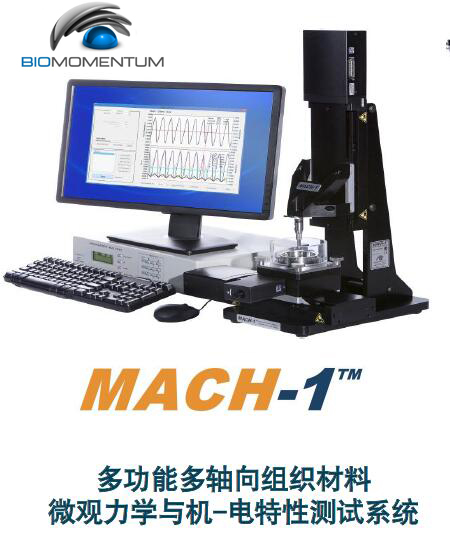
biomomentum mach-1 多功能摩擦磨损测试仪 | 该BMM mach-1 多功能摩擦磨损测试仪使用BMM 开发的软件使用垂直平台施加法向力,而其他平台施加旋转或平移运动,您可以轻松确定测试中涉及的摩擦系数和力。摩擦测试的目的涵盖了广泛的兴趣领域。例如,测试一种新型润滑剂的有效性或比较两个样品的表面特性。 | 该系统可模块化集成摩擦磨损、压痕、拉伸、压缩、三弯曲、四点弯曲、扭力、剪切、摩擦磨损、3D轮廓表面形貌表征、电特性等各种力电多物理场测试。 能对极软、极硬组织材料进行精密可靠的机械刺激和表征。允许表征的机械性能包括刚度、强度、模量、粘弹性、塑性、硬度、附着力、肿胀和松弛位移控制运动各种机械特性。 | 点击查看 该系统多功能多组织材料各种力-电特性测试介绍
| | 
| 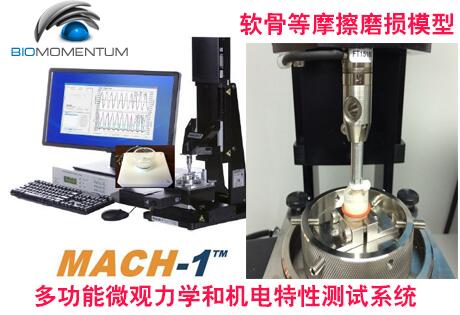 
摩擦 摩擦测试确定两个表面在受到接触力时相互滑动的难易程度。在这些测试中通常观察到两种主要现象:静摩擦和动摩擦。静摩擦力是阻止物体从静止状态移动的力,而动摩擦力是在两个表面已经运动时作用于它们之间的力。BMM 开发的软件使用垂直平台施加法向力,而其他平台施加旋转或平移运动,您可以轻松确定测试中涉及的摩擦系数和力。摩擦测试的目的涵盖了广泛的兴趣领域。例如,测试一种新型润滑剂的有效性或比较两个样品的表面特性。
Biomomentum Mach-1的摩擦磨损测试功能,主要应用于生物医学工程和组织工程领域,核心场景是评估生物组织(尤其是关节软骨)的摩擦学特性。 这台系统的特之处在于,它能在模拟生理环境的条件下,对天然或工程化组织进行高精度的摩擦测试。摩擦测试通常需要使用多轴力传感器,这也是该系统能同时进行压缩、剪切、扭转等测试的基础。 核心应用场景:软骨与关节研究这是目前成熟、文献多的应用领域。具体可以细分为: 软骨摩擦与润滑机制研究:对天然或再生软骨进行摩擦和磨损测试,研究其表面润滑性能。系统可测试各种组织工程材料,如软骨、肌腱、皮肤、脑组织等。其3D法向压痕功能,特别适合评估非平面、不规则表面的软骨修复效果。 组织工程与再生医学评估:量化评估组织工程构建物(如用于修复软骨的支架材料)的摩擦学特性,确保植入物具有良好的力学和润滑性能。 病理状态与退化研究:研究骨关节炎等疾病状态下,软骨组织退变过程中的摩擦性能变化,为疾病机理和治疗提供数据支持。
医院科室关联与应用这些研究直接对应到医院中的以下几个关键科室: 骨科 (Orthopedics):研究关节置换材料、软骨修复方案、骨关节炎病理。Mach-1初即为软骨力学检测而开发,相关应用广泛。 康复医学科 / 运动医学科 (Rehabilitation / Sports Medicine):评估肌腱、韧带等软组织的力学与摩擦性能,用于运动损伤修复和康复方案制定。 口腔科 / 颌面外科 (Stomatology / Maxillofacial Surgery):可研究颌骨、牙周组织、颞下颌关节等部位的力学特性。 皮肤科 (Dermatology):测试皮肤的摩擦学性能,可能与创伤愈合、皮肤替代物评估相关。 眼科 (Ophthalmology):用于隐形眼镜等眼科材料的摩擦和力学表征。
特技术优势除了能测,它还测得好、测得多: 测试环境真实:可在液体环境(如PBS缓冲液)中,甚至在培养箱内对活体组织进行测试,结果更接近生理状态。 功能集成度高:作为“一机多能”的综合平台,能在做摩擦测试的同时,同步进行压缩、剪切、扭转、3D压痕等多种力学测试,甚至还能在压缩过程中测量电位分布(力电耦合)。 精度与范围:具备0.1μm位移分辨率和0.025mN力分辨率,能检测微小力信号,同时行程范围大(50-250mm),样品适应性强。
总结Mach-1的摩擦磨损测试功能,主要服务于从基础生物力学研究到临床转化应用的链条。它不仅是骨科和康复科等科室的研究工具,也是组织工程、药物筛选和新型生物材料开发的关键评估平台
|
特点亮点 1、适用样品范围广: 1.1、从骨等硬组织材料到脑组织、眼护等骨组织材料 1.2、从粗椎间盘的样品到j细纤维丝 2、通高量压痕测试分析 ◆样品范围广:极软脑组织泡沫到陶瓷、金属 ◆模量范围广3pa到670Gpa ◆wu需表面平坦,可在不规则表面压痕(刚度、硬度、厚度、表面轮廓等测试) ◆压痕不要求压缩轴垂直于样品表面对齐 ◆可模块化集成多轴向多功能多材料:可集成3D轮廓表面形貌表征、拉伸、压缩、三弯曲、四点弯曲、扭力、剪切、摩擦磨损、电特性等各种力电多物理场测试。 ◆压痕同时可测量厚度信息 ◆红宝石压头,坚固不易断,使用成本低 ◆样品不需要从组织中收集 ◆组织的破坏小 ◆维持被测材料的机械环境及其与周围材料的相互作用 ◆自动mapping ◆亚微米分辨率 ◆一台仪器即可进行从纳米到宏观尺度的压痕
◆从小位移(几纳米)到大位移(大50mm)的压痕
◆大载荷范围(从0.025mN 到 250N)以满足样品特性的要求
◆大载荷范围 对测量粗糙表面尤为有用
◆可以在将样品浸入溶液中的情况下进行 3、力学类型测试分析功能齐:张力,剪切,摩擦,扭转,摩擦和2d/3d压痕,3d表面,3d厚度,粘合,塔接塔接合力等各力学类型支持,微观结构支持,微观微观表征及动词力学分析研究 4、高精度高分辨率: 4.1、位移尺寸达0.1um 4.2、力达0.025mN 5、行程范围广:50-250mm 6、气质、可携带容器内 7、高变观察追踪分析 八款精品、多款、多力精品 9、活性组织分布测试分析 10、产品种类,文献量达上千篇 4、多力偶联测试,如测量旋转中两个软骨表面之间的摩擦系数

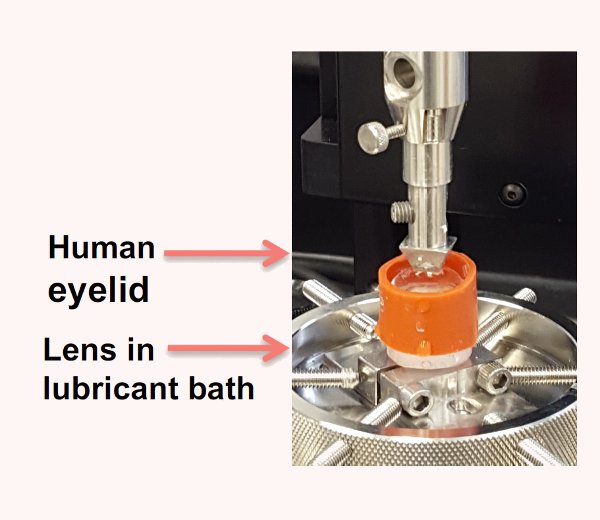
5、微力测试隐形眼睛摩擦测试 
|
BMM 摩擦磨损相关文献案例
Introduction: During daily physical activities, joint articulation results in 3-10% compression in its overall thickness. There is also consensus that articulation is a combined process of shearing and sliding, with relative rotational and translational motions between femoral condyle and tibia cartilage at least at the millimeter scale 2,3. The macroscale motions in the joint which translates...Read More Development of a Sequence of Mechanical Tests for Articular Cartilage at a Single LocationSim S, Chartrand A, Lavallee AP, Tessier J, Garon M, Quenneville E and Buschmann MDOrthopeadic Research Society Annual Meeting in Orlando, 2016
In a recent study, our group has highlighted the importance of considering the natural topographic variability of the mechanical properties over the articular surface, particularly in the context of cartilage repair, where it can screen the effect of a treatment [1]. Moreover, the availability of test sample is limited in those repair studies since the regions of interest are often limited in size....Read More ASTM D1894 - Standard Test Method for Static and Kinetic Coefficients of Friction of Plastic Film and SheetingASTM International, West Conshohocken, PA, 2014, www.astm.org Significance and Use
4.1 Measurements of frictional properties may be made on a film or sheeting specimen when sliding over itself or over another substance. The coefficients of friction are related to the slip properties of plastic films that are of wide interest in packaging applications. These methods yield empirical data for control purposes in film production. Correlation...Read More
ASTM F1538 - Standard Specification for Glass and Glass Ceramic Biomaterials for ImplantationASTM International, West Conshohocken, PA, 2009, www.astm.org Abstract
This specification covers the material requirements and characterization techniques for glass and glass-ceramic biomaterials intended for use as bulk porous or powdered surgical implants, or as coatings on surgical devices, but not including drug delivery systems. Glass and glass-ceramic biomaterials should be evaluated thoroughly for biocompatibility before human use....Read More
ASTM F2451-05 - Standard Guide for in vivo Assessment of Implantable Devices Intended to Repair or Regenerate Articular CartilageASTM International, West Conshohocken, PA, 2010, www.astm.org Significance and Use
This guide is aimed at providing a range of in vivo models to aid in preclinical research and development of tissue engineered medical products intended for the clinical repair or regeneration of articular cartilage.
This guide includes a description of the animal models, surgical considerations, and tissue processing as well as the qualitative and titative...Read More Mach-1 - Friction Testing on a Cartilage Disk or an Osteochondral Core (MA056-SOP08-D v2)Chartrand A and Quenneville EBMM Inc. Laval (QC), Canada, Effective Date: August 24th, 2015 Purpose This procedure describes a standard method to realize a friction test on a cartilage disk or an osteochondral core using the Mach-1 TM mechanical tester.
Scope This procedure can be used for the ex vivo friction test using a planar sliding method on a cartilage disk or an osteochondral core. It is highly...Read More Mach-1 Analysis - Extraction of Mechanical Parameters Following Friction Testing on a Cartilage Disk or an Osteochondral Core (SW186-SOP07-D v2)Chartrand A and Quenneville EBMM Inc. Laval (QC), Canada, Effective Date: August 24h, 2015 Purpose This procedure describes a MatLab-based method to extract mechanical parameters from the Mach-1 result files generated following friction testing on a cartilage disk or an osteochondral core as per MA056-SOP08-D.
Scope
This procedure based on a MatLab code can be applied using any Mach-1 result file obtained following a planar friction test of...Read More Tailoring hydrogel surface properties to modulate cellular response to shear loadingMeinert C, Schrobback K, Levett PA, Lutton C, Sah R and Klein TJActa biomaterialia, October 2016. DOI: 10.1016/j.actbio.2016.10.011 Biological tissues at articulating surfaces, such as articular cartilage, typically have remarkable low-friction properties that limit tissue shear during movement. However, these frictional properties change with trauma, aging, and disease, resulting in an altered mechanical state within the tissues. Yet, it remains unclear how these surface changes affect the behaviour of embedded cells when the...Read More Mechanical characterization of matrix-induced autologous chondrocyte implantation (MACI®) grafts in an equine model at 53 weeksGriffin DJ, Bonnevie ED, Lachowsky DJ, Hart JC, Sparks HD, Moran N and Bonassar LJJournal of biomechanics, 48(10), 1944-1949. (2015) There has been much interest in using autologous chondrocytes in combination with scaffold materials to aid in cartilage repair. In the present study, a total of 27 animals were used to compare the performance of matrix-assisted chondrocyte implantation (MACIs) using a collagen sponge as a chondrocyte delivery vehicle, the sponge membrane alone, and empty controls. A total of three distinct types of...Read More Effect of synovial fluid on boundary lubrication of articular cartilageSchmidt TA and Sah RLOsteoarthritis Cartilage. 2007 Jan;15(1):35-47. Epub 2006 Jul 21 OBJECTIVES: The lubrication of articulating cartilage surfaces in joints occurs through several distinct modes. In the boundary mode of lubrication, load is supported by surface-to-surface contact, a feature that makes this mode particularly important for maintenance of the normally pristine articular surface. A boundary mode of lubrication is indicated by a kinetic friction coefficient...Read More Combined Mechanical Characterizations Increases Sensitivity in the Assessment of Human Cartilage DegenerationSim S, Hadjab I, Chevrolat L-A, Masse M, Tong AL, Lavigne P, Garon M, Quenneville E and Buschmann MDAccepted for a podium presentation at ORS 2017 Introduction: We published a recent study showing superior sensitivity of electromechanical and indentation (instantaneous response) assessments versus well-established techniques, including histological Mankin score, to characterize cartilage degeneration. This study aims to determine whether the combination of instantaneous, relaxation and equilibrium mechanical properties and friction...Read More Evaluation of genipin for stabilization of decellularized porcine cartilageElder S, Pinheiro A, Young C, Smith P and Wright EJ Orthop Res. 2016 Nov 18. doi: 10.1002/jor.23483 Abstract We speculate that an acellular osteochondral xenograft may be a good alternative to allografts for repair of focal articular cartilage lesions. In order to make a xenograft resistant to enzymatic degradation and to prevent a chronic immune response it may beneficial to stabilize it through crosslinking. The concept is analogous to treatment of porcine bioprosthetic heart...Read More Biomechanics and MechanoBiology of Human Cartilage ArticulationHsu FH, Alonso E, Raleigh AR, Saleh AA, Masuda K, Lotz MK, Chen AC and Sah ROrthopeadic Research Society Annual Meeting, 2016, Orlando, USA, Poster abstract 1428 Introduction: During joint articulation, cartilage, particularly that near the articular surface, undergoes a complex combination of compression, shear, and sliding.1,2 In vitro analyses have focused on cartilage biomechanics in response to relative surface movement at a constant velocity after startup. However, joint movement typically involves variability in the relative surface velocity....Read More Composite hydrogel: A high fidelity soft tissue mimic for surgeryTan, Z., Dini, D., Rodriguez y Baena, F., & Forte, A. E.Materials & Design, 160, 886894. https://doi.org/10.1016/j.matdes.2018.10.018 Accurate tissue phantoms are difficult to design due to the complex non-linear viscoelastic properties of real soft tissues. A composite hydrogel, resulting from a mix of poly(vinyl) alcohol and phytagel, is able to reproduce the viscoelastic responses of different soft tissues due to its compositional tunability. The aim of this work is to demonstrate the flexibility of the composite hydrogel...Read More The role of synovial fluid constituents in the lubrication of collagen-glycosaminoglycan scaffolds for cartilage repairAustyn R. Matheson, Eamon J. Sheehy, Gregory D. Jay, W. Michael Scott, Fergal J. O'Brien, Tannin A. SchmidtJournal of the Mechanical Behavior of Biomedical Materials, 2021, 104445, ISSN 1751-6161, https://doi.org/10.1016/j.jmbbm.2021.104445 Abstract
Extracellular matrix (ECM)-derived scaffolds have shown promise as tissue-engineered grafts for promoting cartilage repair. However, there has been a lack of focus on fine-tuning the frictional properties of scaffolds for cartilage tissue engineering as well as understanding their interactions with synovial fluid constituents. Proteoglycan-4 (PRG4) and hyaluronan...Read More
Evaluation of in vitro contact lens friction: Effects of recombinant human proteoglycan 4 and test counterfaceChan, AmandaMaster thesis. University of Calgary, Calgary, AB. doi:10.11575/PRISM/5357 http://hdl.handle.net/1880/106276 |
相关产品推广 1、液晶配向摩擦机,取向摩擦机,液晶取向摩擦机装置,液晶面板取向机装置 2、美国proto-tech摩擦磨损试验机 3、德国smd摩擦磨损试验机
世联博研公司销售设备、租赁和承接实验技术服务一站式服务 我们世联博研公司专注生物力学、3D生物打印、再生医学、生物医学工程、微流控&组织器官芯片、细胞微环境在内的等生命科学国际前沿产品与技术引进中国,为中国科研学者提供专业、实效的仪器设备、耗材、试剂以及科研技术服务一站式解决方案: 1、材料和组织综合微观机械特性方位测试服务频道介绍 我公司联合加拿大BMM 生物力学服务专家,提供各种物材料、组织、细胞构建体微观机-电特性方位的测试服务,23年服务经验支持! ●量身定制测试方案 ●国际标准技术高度可控 ●遵守标准的操作程序 ●可靠的测试协议标准 ●符合良好实验室规范准确数据分析报告 2、点击此处查看更多细胞力学、微观组织材料力学设备销售,提供细胞应力加载培养、微观力学测试分析系统等设备 3、点击查看三维细胞、组织、类器官培养设备大
|